
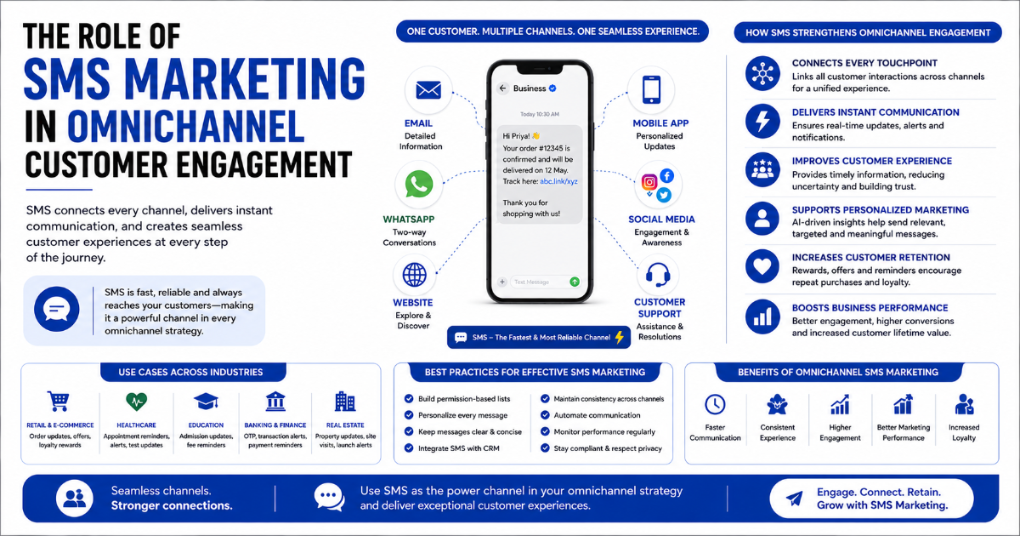
The Role of SMS Marketing in Omnichannel Customer Engagement
Today's customers expect businesses to provide a seamless experience across every communication channel. Whether they interact through a website, mobile app, email, WhatsApp, or SMS, they want consistent, personalized, and timely communication. This is why Omnichannel Customer Engagement has become a key strategy for businesses aiming to build stronger customer relationships.
Among all communication channels, SMS Marketing continues to play a vital role due to its speed, reliability, and ability to deliver important information directly to customers. When integrated with other channels, SMS becomes a powerful tool that enhances customer experiences, supports marketing campaigns, and improves business communication.
This guide explains how SMS marketing fits into an omnichannel strategy and why it remains essential for businesses in 2026.
What is Omnichannel Customer Engagement?
Omnichannel Customer Engagement is a strategy that connects multiple communication channels into one unified customer experience. Instead of treating each channel separately, businesses ensure that every interaction is consistent and connected.
Common communication channels include:
SMS
Email
WhatsApp
Mobile Applications
Websites
Social Media
Customer Support Systems
CRM Platforms
The goal is to allow customers to move seamlessly between channels while receiving relevant and personalized communication.
Why SMS Marketing is Essential in an Omnichannel Strategy
SMS is one of the fastest and most dependable communication channels available. Unlike channels that rely on internet access or platform algorithms, SMS reaches customers directly on their mobile devices.
Businesses use SMS for:
Order confirmations
Appointment reminders
OTP verification
Delivery updates
Payment notifications
Promotional campaigns
Event reminders
Customer feedback requests
Because SMS is immediate, it serves as an excellent channel for time-sensitive communication within an omnichannel strategy.
How SMS Strengthens Omnichannel Customer Engagement
1. Connects Every Customer Touchpoint
Customers may discover a product through social media, browse your website, ask questions on WhatsApp, and complete a purchase through your mobile app.
SMS helps connect these touchpoints by sending:
Registration confirmations
Purchase updates
Shipping notifications
Service reminders
Loyalty rewards
This creates a smooth and consistent customer journey.
2. Delivers Instant Communication
Speed matters in customer engagement.
SMS enables businesses to instantly communicate:
Order status
Payment confirmations
Booking updates
Emergency alerts
Limited-time offers
Real-time communication increases customer confidence and satisfaction.
3. Improves Customer Experience
Customers value businesses that provide clear and timely updates.
SMS improves customer experience by reducing uncertainty and keeping customers informed throughout their journey.
Examples include:
Appointment reminders
Delivery tracking
Account notifications
Renewal reminders
Consistent communication helps build trust.
4. Supports Personalized Marketing
Modern Business Messaging Platforms use AI and customer data to personalize SMS campaigns.
Businesses can personalize messages based on:
Customer names
Purchase history
Preferences
Geographic location
Loyalty status
Previous interactions
Relevant communication increases engagement and strengthens customer relationships.
5. Increases Customer Retention
Retaining existing customers is often more cost-effective than acquiring new ones.
Businesses use SMS to send:
Loyalty rewards
Exclusive discounts
Membership renewals
Birthday offers
Personalized recommendations
These interactions encourage repeat purchases and long-term customer loyalty.
SMS and Other Communication Channels
SMS + Email
Email provides detailed information, while SMS delivers immediate notifications.
Example:
Email: Product catalog
SMS: "Your exclusive offer expires today."
SMS + WhatsApp
WhatsApp supports interactive conversations, while SMS ensures critical updates reach every customer.
Example:
WhatsApp: Product inquiry
SMS: Order confirmation and delivery updates
SMS + Mobile Apps
Push notifications are effective for app users, but SMS reaches customers even when notifications are disabled.
Businesses often combine both channels for maximum visibility.
SMS + CRM Systems
Integrating SMS with CRM software enables businesses to:
Automate follow-ups
Track customer interactions
Personalize communication
Improve customer service
Benefits of SMS in Omnichannel Engagement
Faster Customer Communication
Deliver important updates instantly.
Consistent Customer Experience
Ensure customers receive relevant information across all channels.
Higher Customer Engagement
Encourage more interactions through personalized messaging.
Better Marketing Performance
Improve campaign effectiveness by combining SMS with email, WhatsApp, and social media.
Increased Customer Loyalty
Build long-term relationships through timely and valuable communication.
Better Business Efficiency
Automate customer communication and reduce manual tasks.
Industries That Benefit from Omnichannel SMS Marketing
Retail
Personalized offers, loyalty rewards, delivery updates.
E-commerce
Order confirmations, abandoned cart reminders, promotional campaigns.
Healthcare
Appointment reminders, test results, wellness notifications.
Education
Admission updates, fee reminders, exam schedules.
Banking & Finance
OTP authentication, transaction alerts, payment reminders.
Real Estate
Property updates, site visit confirmations, project launch announcements.
Hospitality
Booking confirmations, check-in reminders, promotional offers.
AI is Enhancing Omnichannel SMS Marketing
Artificial Intelligence is making omnichannel engagement smarter through:
Predictive customer behavior
Intelligent audience segmentation
Personalized messaging
Automated workflows
Smart campaign scheduling
Real-time analytics
AI enables businesses to deliver more relevant communication while improving efficiency.
Best Practices for Omnichannel SMS Marketing
To maximize customer engagement:
Build permission-based contact lists.
Personalize every SMS campaign.
Keep messages clear and concise.
Integrate SMS with CRM and marketing platforms.
Maintain consistent messaging across all channels.
Automate repetitive communication.
Monitor campaign performance.
Respect customer privacy and compliance regulations.
Common Mistakes to Avoid
Businesses should avoid:
Sending duplicate messages across channels.
Ignoring customer communication preferences.
Overloading customers with promotions.
Using inconsistent messaging.
Failing to personalize communication.
Not measuring campaign performance.
A well-planned omnichannel strategy focuses on delivering value rather than increasing message volume.
Why Businesses Need a Business Messaging Platform
A reliable Business Messaging Platform enables organizations to manage customer communication efficiently through:
Bulk SMS Campaigns
SMS API Integration
WhatsApp Business API
Email Integration
Customer Segmentation
AI Automation
Real-Time Analytics
Campaign Scheduling
Delivery Reports
Secure Messaging
With these capabilities, businesses can create connected customer experiences while improving operational efficiency.
Future of Omnichannel Customer Engagement
As customer expectations continue to evolve, omnichannel engagement will become increasingly intelligent.
Emerging trends include:
AI-powered personalization
Predictive messaging
Cross-channel automation
Conversational AI
Rich Communication Services (RCS)
Advanced customer journey mapping
Unified communication platforms
Businesses investing in omnichannel strategies today will be better prepared to meet tomorrow's customer expectations.
Conclusion
SMS Marketing plays a crucial role in Omnichannel Customer Engagement by providing fast, reliable, and personalized communication that complements email, WhatsApp, mobile apps, and other digital channels. Rather than replacing these platforms, SMS enhances the overall customer experience by delivering timely updates, increasing engagement, and strengthening customer relationships.