
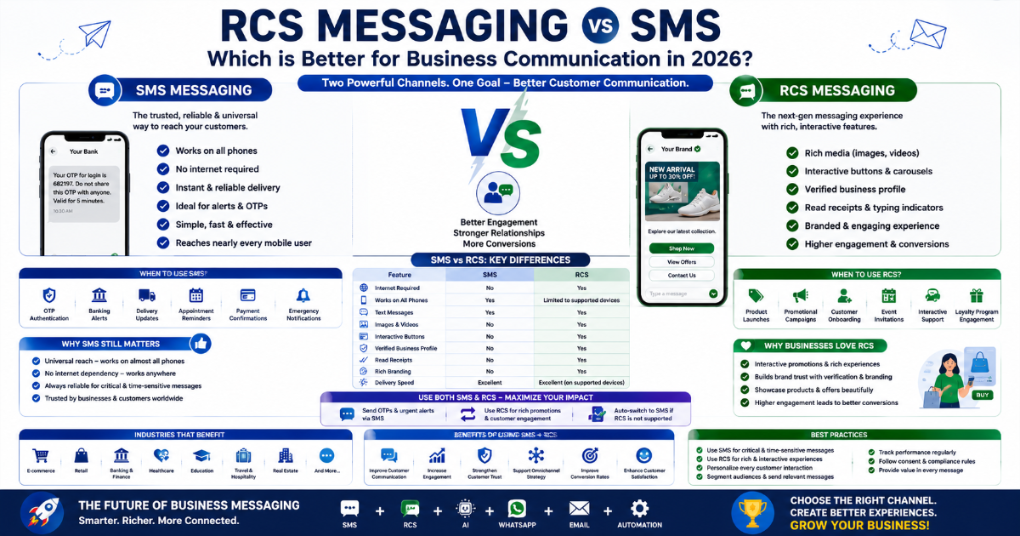
Customer communication is evolving rapidly. While SMS Marketing has been a trusted business communication channel for decades, a newer technology called Rich Communication Services (RCS) is changing how brands interact with customers.
Businesses now have the opportunity to move beyond plain text messages by offering interactive, branded, and multimedia experiences. However, traditional SMS still remains one of the most reliable communication methods available.
So, which one should businesses choose?
The answer depends on your business goals, customer preferences, and communication strategy. Understanding the strengths of both technologies can help you create better customer experiences while improving engagement and conversions.
What is SMS?
Short Message Service (SMS) allows businesses to send plain text messages directly to mobile phones without requiring an internet connection.
Businesses commonly use SMS for:
OTP verification
Order confirmations
Appointment reminders
Payment alerts
Delivery notifications
Promotional campaigns
SMS works on virtually every mobile device, making it one of the most dependable communication channels.
What is RCS Messaging?
Rich Communication Services (RCS) is the next generation of mobile messaging. It supports rich media, interactive content, and branded conversations, providing a more engaging customer experience.
RCS features include:
High-quality images
Videos
Product carousels
Interactive buttons
Suggested replies
Verified business profiles
Rich branding
Read receipts
Typing indicators
RCS delivers an app-like experience directly within the messaging application.
SMS vs RCS: Key Differences
FeatureSMSRCSInternet RequiredNoYesWorks on All PhonesYesLimited to supported devicesText MessagesYesYesImages & VideosNoYesInteractive ButtonsNoYesVerified Business ProfileNoYesRead ReceiptsNoYesRich BrandingNoYesDelivery SpeedExcellentExcellent (on supported devices)
Why SMS Still Matters
Despite the growth of RCS, SMS continues to be essential because:
It reaches nearly every mobile phone.
It doesn't require internet connectivity.
It's ideal for urgent notifications.
It provides reliable delivery for OTPs and transactional messages.
It's simple, fast, and trusted by businesses worldwide.
For critical communication, SMS remains one of the most dependable channels.
Why Businesses Are Exploring RCS
RCS offers a richer customer experience by enabling:
Interactive Promotions
Customers can browse products, view images, and click action buttons without leaving the messaging app.
Brand Trust
Verified business profiles help customers recognize authentic brands.
Better Engagement
Interactive content encourages customers to explore products and services more actively.
Rich Product Showcases
Businesses can display product catalogs, pricing, and promotional offers within a single conversation.
When Should Businesses Use SMS?
SMS is ideal for:
OTP authentication
Banking alerts
Delivery updates
Appointment reminders
Emergency notifications
Payment confirmations
Time-sensitive communication
These use cases require reliability and universal reach.
When Should Businesses Use RCS?
RCS is well-suited for:
Product launches
Promotional campaigns
Customer onboarding
Event invitations
Interactive customer support
Loyalty program engagement
Rich marketing campaigns
Businesses can create visually appealing experiences that drive customer interaction.
Can SMS and RCS Work Together?
Absolutely.
A modern Business Messaging Platform can combine both technologies to create a flexible communication strategy.
For example:
Send OTPs and urgent alerts via SMS.
Use RCS for product promotions and interactive marketing.
Automatically switch to SMS if a customer's device doesn't support RCS.
This hybrid approach ensures businesses maintain both reach and engagement.
Benefits of Using Both SMS and RCS
Businesses can:
Improve customer communication.
Deliver personalized experiences.
Increase campaign engagement.
Strengthen customer trust.
Support omnichannel marketing strategies.
Enhance customer satisfaction.
Improve conversion rates.
Using the right channel for the right purpose creates a more effective communication strategy.
Industries That Benefit
E-commerce
Product launches, shipping updates, abandoned cart reminders.
Retail
Loyalty programs, personalized offers, seasonal promotions.
Banking & Finance
OTPs, transaction alerts, account notifications.
Healthcare
Appointment reminders, wellness campaigns, prescription updates.
Education
Admission notifications, exam reminders, event invitations.
Travel & Hospitality
Booking confirmations, itinerary updates, promotional offers.
Best Practices
To maximize business messaging success:
Use SMS for critical and time-sensitive notifications.
Use RCS for engaging marketing campaigns.
Personalize every customer interaction.
Segment audiences based on customer behavior.
Track campaign performance regularly.
Respect customer consent and messaging regulations.
Future of Business Messaging
The future of customer communication will combine:
SMS
RCS
AI-powered personalization
WhatsApp Business messaging
Email automation
Customer journey automation
Businesses that embrace multiple communication channels will deliver better customer experiences while staying ahead of evolving customer expectations.
Conclusion
Both SMS and RCS Messaging have important roles in modern business communication. SMS remains the most reliable channel for instant, universal communication, while RCS provides rich, interactive experiences that enhance customer engagement.
Rather than choosing one over the other, businesses should adopt a strategy that leverages the strengths of both. By integrating SMS for essential notifications and RCS for immersive customer interactions, organizations can build stronger relationships, improve marketing performance, and deliver a seamless communication experience.